
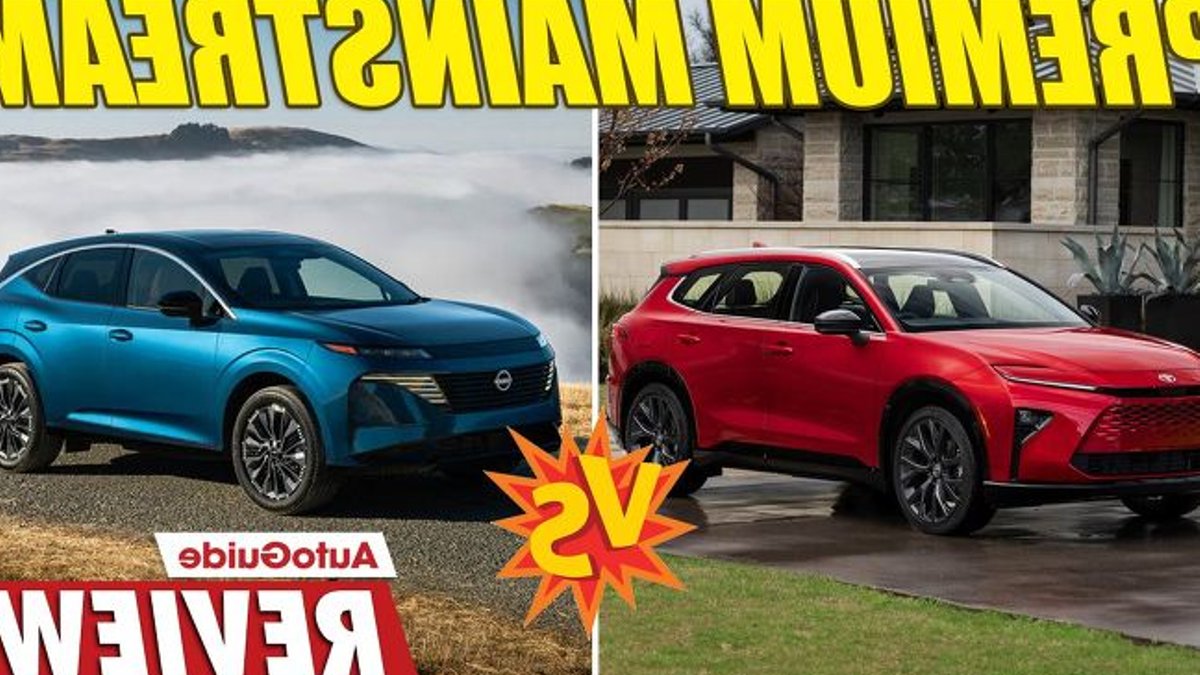
The 2026 Nissan Murano and Toyota Crown Signia take different paths in the semi-premium two-row SUV segment. The Murano arrives as a redesigned version of a familiar model, while the Crown Signia recently surpassed competitors in testing. Their differences go beyond appearance, affecting how each vehicle performs and what it offers drivers who want both practicality and refinement.
Styling and cabin: contrasting approaches
The Murano’s exterior receives mixed feedback. Its long hood, sloping roofline, and standard 21-inch wheels maintain the model’s recognizable shape. A chrome blade along the roof, inspired by the Nissan Z, adds a sporty element, and the taillights with tiny lighting elements create a distinctive look from behind. The front design combines elements in a way that doesn’t fully harmonize.
Inside, the Murano adopts a travel-inspired theme. A color-changing trim strip across the dashboard references the volcanic island of Murano, suggesting adventure. Wooden touch controls from the Ariya replace physical buttons, favoring appearance over tactile response. The blue leather seats feature detailed stitching that competes with some luxury brands. Rear seat materials fall slightly short, and cabin noise increases noticeably at highway speeds.
The Crown Signia takes a quieter approach. Its front end matches the corporate design of the Prius and Camry, while the raised wagon profile resembles the Subaru Outback. The interior presents a unified look with rose-gold trim accents and a smooth transition between the digital driver display and infotainment screen. Soft materials extend to the rear door sills, and the back seats provide generous legroom along with a panoramic moonroof that enhances spaciousness. Front seats sit lower and feel tighter, a compromise for the wagon’s sleeker shape.
Both interiors aim for comfort but serve different preferences. The Murano’s bold design contrasts with the Signia’s subtle elegance, though neither completely avoids trade-offs between SUV practicality and car-like handling.
Related: China targets Volkswagen plants
Performance and efficiency: hybrid systems lead
The Murano moves away from its previous V6 engine. The new powertrain delivers strong performance on paper but reveals inconsistencies in real-world driving. The transmission often hesitates, holding gears too long during quick acceleration.
The Crown Signia’s hybrid setup delivers smooth acceleration when conditions are right, though power can feel limited when the battery charge drops. Unlike the Murano’s occasionally unpredictable transmission, the Signia’s continuously variable setup ensures steady performance.
On the road, the Murano’s weight becomes noticeable. Steering feels artificially heavy, and the suspension transmits more road noise than the Signia’s. The Toyota drives with greater lightness and better body control during turns. Its 6.7 inches of ground clearance and wagon-like stance contribute to a stable, car-like feel, while the Murano’s taller ride height and firmer suspension emphasize a traditional SUV experience.
This difference highlights a shift in the industry. Hybrid powertrains are no longer optional; they’ve become a standard expectation for buyers focused on efficiency.
Technology and pricing: small details make a difference
The Murano’s infotainment system stands out for its practicality. A dual-screen layout allows more customization than the Signia’s, and steering wheel controls help drivers keep their hands on the wheel. Navigation graphics look outdated, and the transmission’s occasional issues affect the overall experience. Nissan’s ProPilot Assist 2.1, a hands-free driving feature, comes as part of a $2,700 tech package, though the base model still includes useful options like a 360-degree camera and wireless charging.
Related: The Hidden Gems: Best-Selling Used Cars Under $15,000
The Crown Signia offers a more intuitive interface, though its infotainment system isn’t as polished. A wireless phone charger with a clever retention design and a dedicated headlight washer button add thoughtful details. Comfort features include ventilated front and rear seats, a heated steering wheel, and a power liftgate as standard. The moonroof and soft-touch rear door sills reinforce the vehicle’s premium positioning, though the front seats don’t feel as roomy as the Murano’s.
Pricing adds another layer to the comparison. In the U.S., the Murano starts at $51,795 with destination fees, slightly below the Signia’s $51,850 as-tested price. Adding options like a black roof or the tech package can push the Nissan above the Toyota. Canadian pricing varies due to tariffs, with the Murano ranging from $56,828 to $60,848 CAD, while the Signia remains at $61,455 CAD in its fully equipped version.
The Murano’s lower starting price and simpler trim structure may attract buyers who value cost, but the Signia’s hybrid efficiency and smoother driving experience could make the higher price worthwhile. The decision comes down to whether a driver prefers the Murano’s striking design and SUV feel or the Signia’s quiet sophistication and fuel savings.
Neither vehicle completely avoids the compromises of its category. The Murano’s divisive styling and uneven transmission undermine its ambitions, while the Signia’s tight front seats and wagon-like shape may not appeal to those wanting a full SUV. Still, in a market where efficiency and comfort increasingly overlap, the Crown Signia aligns more closely with future trends.


