
The Jaguar Leaper is one of the most iconic bonnet ornaments in automotive history. It was designed by Frederick Gordon Crosby after Sir William Lyons objected to an aftermarket ornament on an SS Jaguar Saloon. The design evolved in 1955 with the addition of outstretched rear legs, a feature introduced with the second generation model, which replaced the original design that had been in use until 1951.
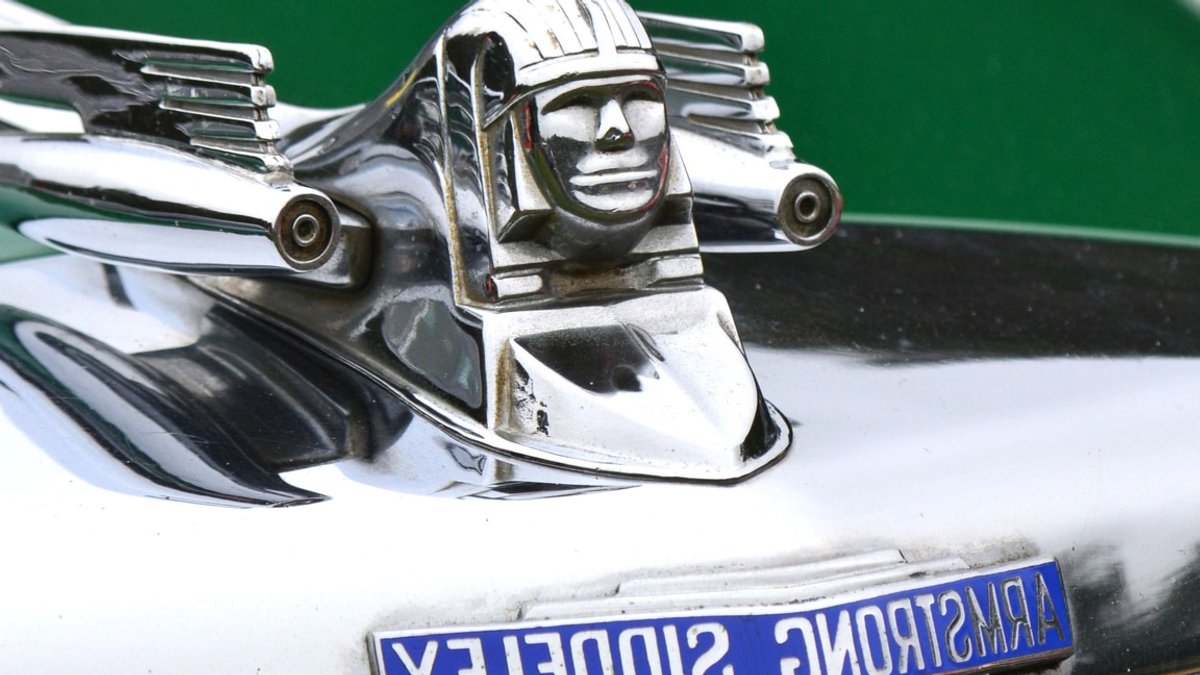
The Packard Goddess of Speed featured Nike, the Greek god of victory, grasping a wheel, a design by John D. Wilson that aimed to incorporate Greek mythology into Packard’s branding. This earned the unfortunate nickname “donut chaser” due to Nike’s outstretched arms. Meanwhile, the Armstrong Siddeley Rocket Sphinx combined a Sphinx with two jet engines, reflecting the company’s merger with Armstrong Whitworth in 1919, when the ship and aircraft manufacturer acquired Siddeley-Deasy. The Sphinx mascot, which first appeared in the 1910s, was originally associated with the company’s slogan, “as silent as the Sphinx.”
The Rolls-Royce Spirit of Ecstasy, first registered in 1911, remains a symbol of luxury. Its 2022 redesign made it more aerodynamic for the all-electric Spectre. Each ornament is still handcrafted using the lost wax casting technique, a traditional method that ensures meticulous detail and quality.
The Bugatti dancing elephant, created by Rembrandt Bugatti, adorned the Type 41 Royale. Rembrandt, inspired by his namesake, the Dutch painter, sculpted the piece at just 17 years old, having already debuted his first sculpture at an exhibition in Milan. His passion for animals and talent as a sculptor led to the creation of the elephant in 1904, which his brother Ettore Bugatti later used as the radiator cap for the Royale.
The Wills Sainte Claire Grey Goose featured a Canada goose in flight, designed by Childe Harold Wills, an engineer and metallurgist who also created the Ford blue oval logo. After leaving Ford with a hefty severance package, Wills founded his own company, Wills Sainte Claire, though the cars were ultimately too complex and expensive for mass production.
The Duesenberg ornament, a sharp bird sculpture, highlighted the era’s disregard for pedestrian safety. Similarly, the Pontiac Chieftain used a Native American chief’s head as its bonnet ornament, introduced in 1949 when the Chieftain replaced the Torpedo as Pontiac’s smaller, more affordable model. Some versions featured an orange plastic ornament that lit up with the headlights.
Lincoln’s bonnet ornaments included a greyhound commissioned by Edsel Ford, son of Henry Ford, in the 1920s, and a knight’s helmet that replaced it. The greyhound design was later adopted by Ford for the Model 48 in the 1930s, demonstrating its enduring appeal.


