
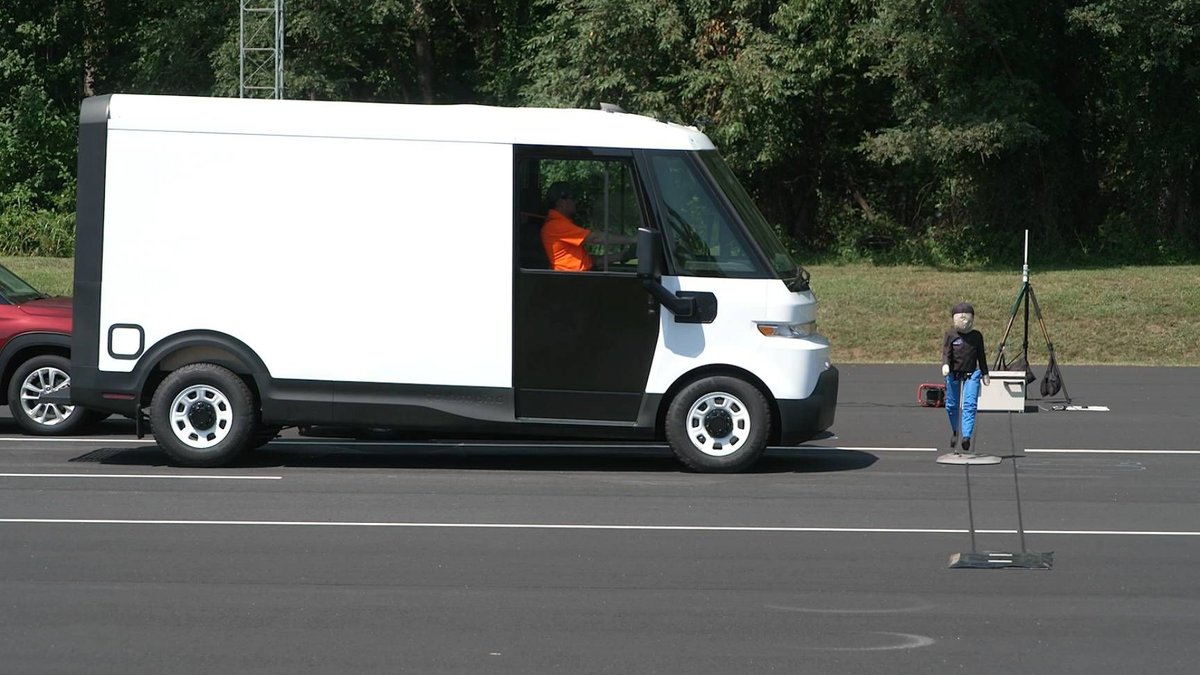
The Insurance Institute for Highway Safety (IIHS) has conducted its first-ever front-crash-avoidance tests on cargo vans and heavy-duty pickup trucks. The results reveal a stark contrast in performance compared to passenger cars, with many commercial vehicles struggling to identify and avoid dangerous situations. This disparity is particularly concerning given the size and weight of these vehicles, which can exacerbate the severity of crashes.
Poor Ratings for Many Models
In the tests, which included vehicle-to-vehicle and pedestrian-crash-avoidance scenarios, several models received “Marginal” or “Poor” ratings. According to the IIHS, Chevrolet’s Express 2500 and GMC’s Savana 2500 cargo vans earned “Poor” ratings in both vehicle-to-vehicle and pedestrian crash tests. They were, in fact, the only vehicles to earn double Poors in the IIHS tests because they lacked automatic emergency braking (AEB), though they are available along with an optional forward collision warning system.
Other models, such as the 2025 Ford F-350, 2025-2026 GMC Sierra 3500, and 2025-2027 Ram 3500, showed variable performance in the vehicle-to-vehicle tests. The test evaluates both forward collision warning and AEB at different speeds with passenger car and motorcycle targets, as well as forward collision warning with a semitrailer. The motorcycle target proved particularly challenging, with some vehicles failing to slow at all or not providing timely warnings to drivers.
Pedestrian Detection Issues
While cargo vans like the BrightDrop 400 and Rivian’s RCV-Delivery 500 earned “Good” ratings in pedestrian crash avoidance, most pickups struggled with detecting and avoiding children during the day. The IIHS suggests that the sensor positioning near the rearview mirror may be too high to effectively detect smaller individuals. In some cases, the child dummy was detected at longer distances but then “disappeared” as the trucks approached. The GMC Savana 2500 and Chevrolet Express 2500, which received “Poor” ratings, even failed to slow down during nighttime trials with an adult.
A Wake-Up Call for Manufacturers
IIHS President David Harkey described the results as “a wake-up call for commercial-vehicle makers.” With 6,215 fatalities in 2024 involving heavy- or medium-duty vehicles, the need for improved safety features is clear. According to the IIHS, these vehicles accounted for 16% of all roadway fatalities in the U.S. in 2024. Despite a few standout performances, such as the Mercedes-Benz Sprinter 2500, which earned a “Good” rating in vehicle-to-vehicle front crash prevention, and the BrightDrop 400 and RCV-Delivery 500, which managed the same for pedestrian crash avoidance, the overall results indicate a widespread deficiency in safety technology across the commercial vehicle sector.
Among the 11 vehicles tested, there were as many “Poor” ratings (nine) as there were “Marginal” and “Acceptable” ratings combined. Only two models—the BrightDrop 400 and Mercedes-Benz Sprinter 2500—achieved a combination of “Good” and “Acceptable” ratings. Excluding these two, the number of “Poor” ratings equaled the total of all other ratings, showing the industry’s need for improvement.


