
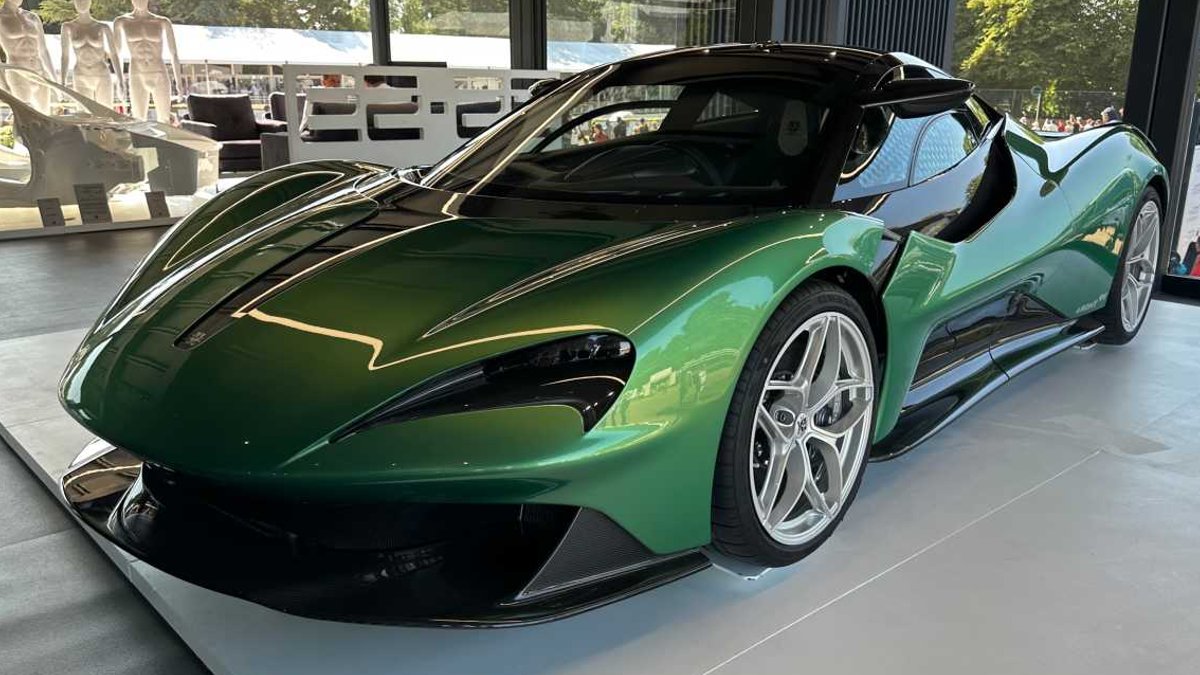
The Lanzante 95-59 is a three-seat hypercar created to commemorate the 30th anniversary of the McLaren F1 GTR’s 1995 Le Mans victory, a race Lanzante helped engineer. Only 59 units will be produced, each priced at £1.2 million.
McLaren 750S provides the technical basis
Lanzante retuned the 4.0-liter twin-turbo V8 to generate over 850 horsepower and 649 pound-feet of torque—110 horsepower and 60 pound-feet more than the donor car. Power is routed through the same seven-speed dual-clutch transmission and open differential with software-controlled limited-slip functionality.
The target weight is 1,250 kilograms when fitted with the LM30 pack. If achieved, the power-to-weight ratio would reach 700 horsepower per ton, a 167 horsepower-per-ton improvement over the 750S. The LM30 pack saves about 20 kilograms via forged aluminum wheels, Inconel exhaust manifolds, a titanium secondary exhaust system, and titanium body fasteners. Gold heat shields in the engine bay and exhaust subtly reference the original McLaren F1.
The company states the 95-59 will be more practical than most hypercars. A 70-liter motorsport-style fuel cell extends range, while redesigned luggage space and three seats improve long-distance usability.
Paul Howse designed a more restrained exterior
The body was designed by Paul Howse, who also worked on the McLaren P1, 720S, and Artura. The 750S’s headlights remain, but the rest of the bodywork is new. The design replaces sharp edges with softer, sculptural lines that flow into a prominent belt line along the sides. Door inlets are retained but reshaped, and top-mounted rear-view mirrors mimic the original F1’s layout.
At the rear, the 750S’s hydraulic wing stays are kept, though the wing itself is reprofiled. P1-style taillights sweep into a single central exhaust outlet. A large diffuser frames the transmission, a signature detail for the brand. The car currently exists as a “production-intent styling concept,” meaning some production details may still change.
Related: China targets Volkswagen plants
Ueno Grey paint matches the shade of the 1995 Le Mans-winning F1 GTR. The entire body is carbon fiber.
The interior’s most notable change is the seating arrangement. The central driver’s seat is lightweight and adjustable, while the two passenger seats are integrated into the chassis. No cabin images have been released, but Lanzante suggests repurposed McLaren components, possibly from the Speedtail.
While the 95-59 pays tribute to the race car’s legacy, the company insists it is built for driving. It describes the car as a grand tourer—fast yet practical enough for long journeys.
Half of the production run is already reserved
Of the 59 planned units, half were claimed at the time of the announcement. Each costs £1.2 million.
This project differs from previous work. It is not a conversion but a complete reinterpretation of a modern McLaren, created to honor a historic victory.
The 95-59 debuted at the 2026 Goodwood Festival of Speed, where its mix of nostalgia and performance attracted attention. Performance figures, including acceleration and top speed, have not been disclosed.


