
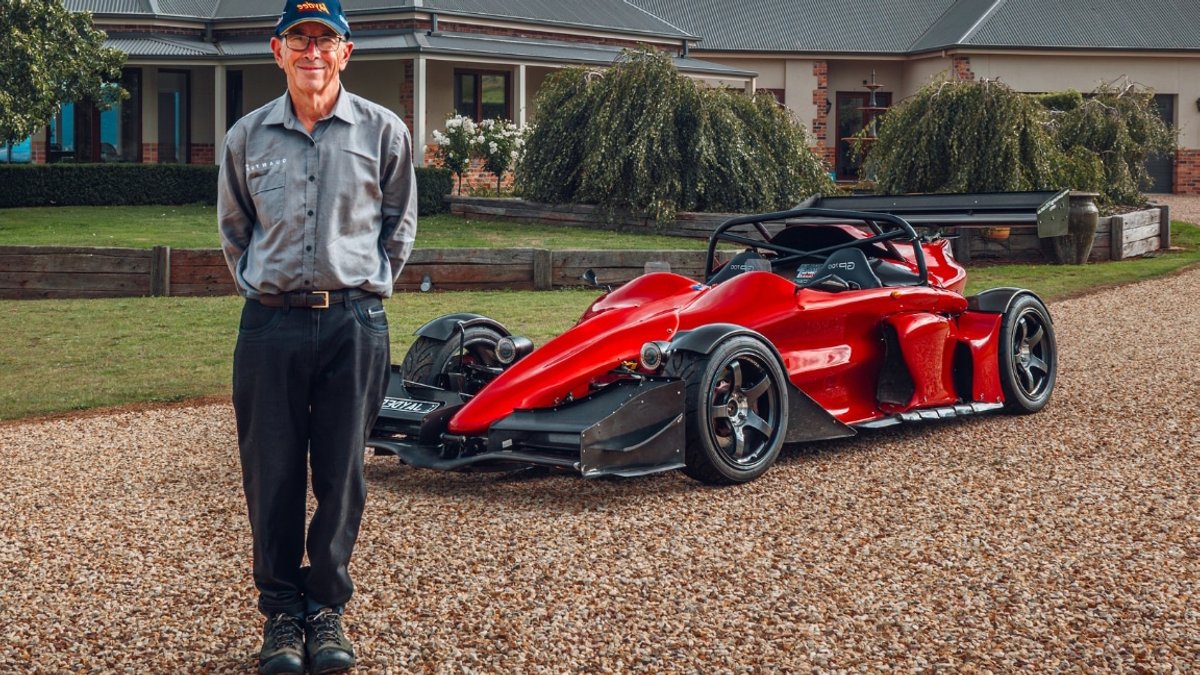
Jeff David points to a graffiti-covered bus stop in a layby, signalling to stop for a quick photo. That is the excuse, anyway. In truth, he needs a moment to stand on solid ground. Riding shotgun with him feels like bench pressing 160kg with a neck brace. The acceleration, after all, pushes 1.2g.
From dirt bikes to a Formula One blueprint
David insists he is “just a bloke in a shed,” but most men do not use a digger to simulate downforce on a homemade hypercar. He started with motorcycles, spending years as a KTM team rider and collecting trophies at endurance races like Finke. He eventually transitioned to cars, importing an Ariel Atom in 2005 and road-legalising it.
That car proved unsatisfactory on public roads. David pulled it to pieces and reworked every single part. He even sent pushrods to a mate at McLaren for strain gauges. When all 400bhp were unleashed, only 15kg was being carried by each front wheel. That is not a recipe for handling.
Read Also: Chinese Carmakers Unveil Bold, Bizarre Tech Innovations
Armed with data from MoTeC systems and simulation tools like Bosch’s motorsport software, he cut into the Atom’s chassis and extended the frame by 12cm. The handling instantly improved. However, the car could not reach 2g without aero. David decided to build his own chassis from scratch, using concepts from Formula One and F2 of that era.
His background in dirt bike tuning became the foundation for the GP700. “The systems I use date back to 1998,” he says. “Compared to bike suspension, road car suspension is prehistoric.” He logged data from his best-performing bikes, translated it into spreadsheets, and built a kinematic model in SolidWorks to apply decades of bike suspension development to a car.
A bespoke engine and chassis
The engine is a custom mongrel based on Honda’s K-series. It combines a CR-V block, a Type R head, and an S2000 F22C crank. Beyond the base castings, everything is custom. Pistons, rods, cams, porting, and manifolds were all hand-shaped and tested on a dyno. Eventually, these components became off-the-shelf products, though without asking David for permission.
Read Also: Analogue Mercedes 500E Restomod Features Tiller and Crank
He also sent a hand-porting cylinder head to 4Piston Racing, who returned two CNC-ported heads. The gearbox is a six-speed, air-shifted Holinger unit. The company used CAD data from David’s rear chassis to design it. That custom gearbox now ends up as OEM equipment on the KTM X-Bow, even though it is coping with two times its rated torque.
When he committed to building a new chassis, weight and strength were the priorities. It also needed to meet Victoria’s strict road registration standards. David enlisted 11 university students completing their final year theses as industry supervisors. Three focused specifically on the chassis, handling CAD work and torsional rigidity.
Testing happened entirely in his shed. He bolted the rear of the chassis to the concrete slab, attached a pipe to the middle, and hung a cement bag off it. He measured deflection with a steel ruler. Between this old-school method and the CAD work, he nailed the design. The rear cross member, cut with a high-pressure water jet, weighs just 2.5kg but can handle 800bhp.
Read Also: Ultra-light Aston Martin AMB 002 debuts
David designed the bodywork to include a Formula One-style front wing and nose. The design went from his imagination into Maya 3D modelling software, and with help from his son Andrew, he refined the surfaces. Foam blocks were CNC routed, layered with raw carbon fibre, and finished by a body shop. David still has the moulds upstairs.
Electronics tie everything together. David worked as an electrical engineer for Honeywell, a background that allows him to speak technically. “Some calculations happen in Emtron, some in MoTeC, and they share data, much like a computer network,” he explains. Many sensors are off the shelf, but the data analysis has been customised over decades of refinement.
A single example and its outcome
The performance figures are substantial. It produces 800 horsepower and weighs 748 kilograms when wet. Acceleration to 100 miles per hour takes 4.4 seconds. The gearing is set to allow a top speed of 193 miles per hour. A lap around Winton National Circuit on Fastestlaps.com shows a time of 1 minute and 25.60 seconds. This result is nearly four seconds faster than a Mercedes-AMG GT R Pro.


