
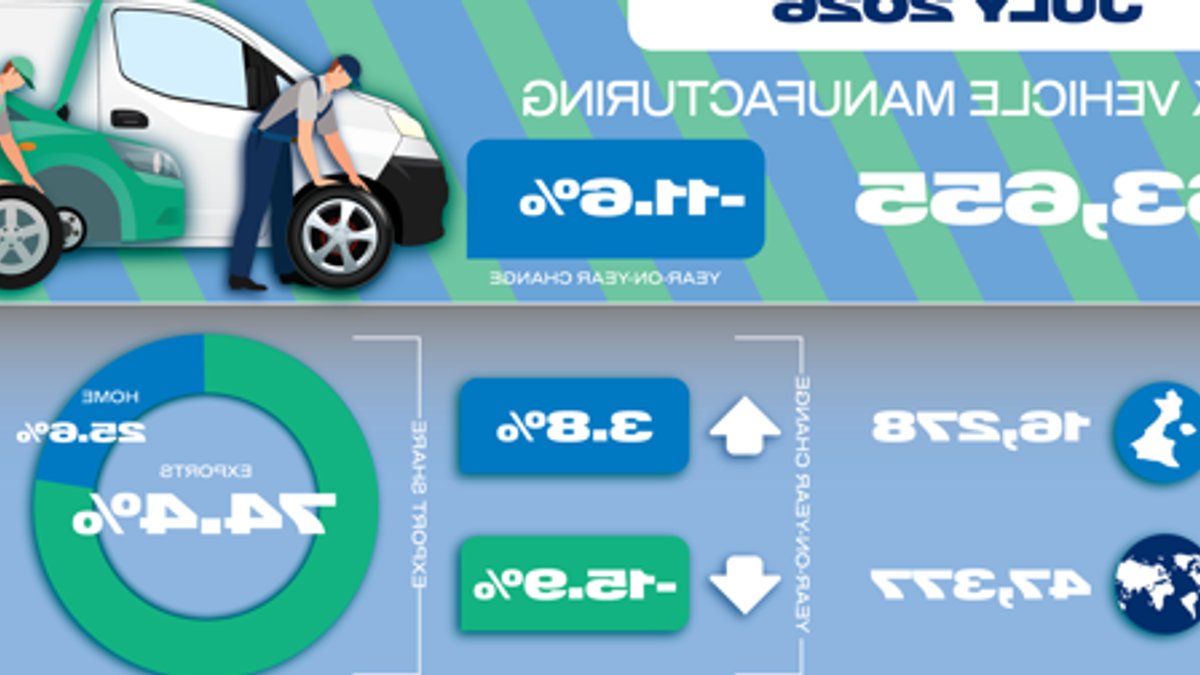
UK vehicle production fell by 11.6% in July, with weaker exports and planned factory shutdowns contributing to the decline, according to the Society of Motor Manufacturers and Traders. A total of 63,655 cars and commercial vehicles were produced by UK factories during the month.
The decline comes despite stronger demand from UK buyers, with domestic production of cars increasing by 9.3%. However, this was insufficient to offset a 15.8% fall in car exports.
Exports to all of the UK’s major overseas markets declined, including the European Union, where shipments fell 15.2%. Exports to the US were down 17.7%, while shipments to Turkey, China and Japan fell by 18.5%, 36.9% and 24.4% respectively.
Commercial vehicle production was particularly weak, falling 34.4% to just 1,888 units. Output for the UK market fell 49.6%, while exports declined by 18.5%.
Related: LNG still a fuel option for UK truck fleets
There was more positive news on the transition to electrified vehicles, however, with production of fully electric and hybrid cars increasing for the first time this year. Electrified car production rose 6.8% in July to 25,678 units, meaning these vehicles accounted for more than four in 10 cars built in the UK.
This growth compares with around three in 10 vehicles a year earlier, highlighting the increasing role of electrified models in UK manufacturing. For fleet operators, the continued growth in electrified vehicle production should support greater availability of new electric and hybrid models.
Year to date, UK factories have produced just under 450,000 cars and commercial vehicles – 8.1% fewer than during the same period in 2025. The SMMT attributed the decline to factors including model changeovers, the closure of a Stellantis manufacturing plant last year and continued uncertainty around trade and investment.
Despite the decline, the latest independent forecast expects UK car and light vehicle production to remain broadly stable at around 740,000 units in 2026, before returning to growth in 2027.
Related: Alphabet GB appoints new sales manager
The SMMT said the UK’s competitiveness and attractiveness to new model investment will be key for future growth. The organisation also called for action on industrial energy costs, which it said will remain around 60% higher than in Europe despite the forthcoming British Industrial Competitiveness Scheme. Trade with the EU is another major concern, with the SMMT warning that proposed ‘Made in the EU’ rules and tougher rules of origin requirements due to take effect in January could put UK-built vehicles at a competitive disadvantage in European markets.
SMMT chief executive Mike Hawes said the July figures demonstrated the “intense pressure” facing UK vehicle manufacturers, with weaker overseas demand and global competition adding to the impact of shutdowns and model changeovers. He said urgent reform of the Zero Emission Vehicle (ZEV) Mandate, lower energy costs and measures to protect free and fair trade with the EU were needed to return UK automotive manufacturing to growth.
For fleets, the health of the domestic automotive industry is significant beyond vehicle supply, with manufacturing investment influencing the availability of new models, supply chain resilience and the pace at which manufacturers can bring new electric vehicles to market.
The latest figures suggest that while the UK’s shift towards electrified vehicle production is gathering pace, the wider manufacturing sector continues to face significant economic and trade pressures.


