
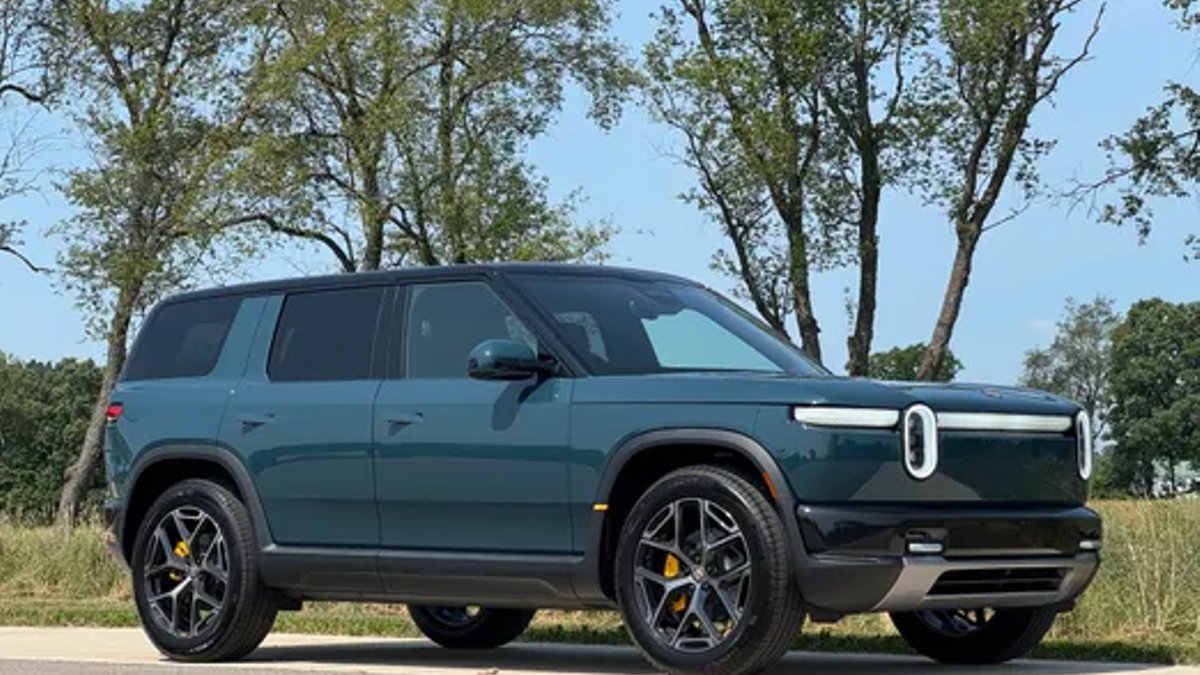
Rivian has launched its second vehicle line, the R2, positioning it as a smaller, more affordable alternative to the R1 series. The new SUV is notably downsized in length, width, and height compared to the R1S, fitting into the compact midsize crossover market. While maintaining the R1’s styling cues, the R2 drops to two rows of seating and offers a more budget-friendly starting price. Four variants are planned, with prices ranging from $46,485 to $59,485, significantly lower than the least expensive R1S at $85,165.
Rivian R2 Overview and Pricing
The R2 Performance, arriving this spring, starts at $59,485 including a $1,495 destination charge. A more affordable version, the R2 Premium, will follow later this year at $55,485. In the first half of 2027, the R2 Standard will debut at $49,985, with an even lower-range version slated for summer 2027 at $46,485. The company discontinued its most affordable R1S variant earlier this year, which had started at $76,990.
Measuring 186 inches long, 78 inches wide, and 67 inches tall on a 115.6-inch wheelbase, the R2 is compact in every dimension. The company aims to attract new buyers by offering a more accessible entry point into its electric vehicle lineup.
Design and Features
The R2 adopts unibody construction instead of the R1’s body-on-frame design, reducing costs and weight while sacrificing some off-road capability. Towing capacity is limited to 4,400 pounds, down from the R1’s higher figures. However, the unibody structure improves space efficiency, providing 29 cubic feet of cargo space with the second row up and 79 cubic feet with seats folded. The front “frunk” adds roughly 5 cubic feet.
Unlike the R1’s advanced air suspension, the R2 uses conventional struts and multilink rear suspension with steel coil springs. Adaptive dampers allow adjustable firmness for different driving conditions. Ground clearance stands at 9.6 inches, with 32-inch tires and approach/departure angles of 25 and 26 degrees, supporting respectable off-road capability. All-wheel drive will be standard on Performance and Premium models, with rear-wheel drive coming for base trims.
Read Also: Dealership saves big with AI solutions
Design, Performance, and Interface Features
During testing, the vehicle delivered abundant thrust when accelerating, enabling quick merging onto highways and rapid lane changes in busy city streets. Both Performance and Premium models share an 88-kWh battery pack, offering approximately 330 miles of range, according to Rivian. This range figure applies to both trims, providing flexibility for drivers. The acceleration performance supports confident merging and responsive driving in dynamic traffic conditions, with the Premium model maintaining strong torque delivery for effortless city and highway maneuvering.
The haptic halo dials on the steering wheel can be set to a single function and be left unchanged, as they are not required for all features. Rivian indicates that new users typically need a few days to adapt to the interface, though one reviewer mastered the system in just 30 minutes. While some drivers prefer simpler controls, the interface offers opportunities for slick personalization through the Rivian app, enabling users to tailor settings to their preferences. The system’s flexibility extends to remote access features, allowing adjustments before entering the vehicle.
Powertrain and Range
Powertrain details reveal the R2 Performance delivers 656 horsepower and 609 lb-ft of torque via dual motors. The Premium model reduces output to 450 horsepower and 537 lb-ft, still achieving 0-60 mph in under five seconds. Base R2 Standard models will feature a single rear motor producing 350 horsepower and 355 lb-ft, paired with an 88-kWh battery for an estimated 345-mile range.
A smaller battery option for the Standard trim promises over 275 miles of range.
Charging infrastructure remains robust, with all models equipped with North America Charging Standard ports. Rivian claims 150 miles of range in 15 minutes on DC fast chargers. Integrated navigation combines Google Maps with Rivian’s system for optimized charging stops.
Read Also: GM to Invest $1B in New EV Battery Cell Technology
Interior Technology and Comfort
The R2’s interior prioritizes software-driven flexibility, featuring a 12.3-inch digital cluster and 15.6-inch touchscreen. Two rotary “haptic halo dials” on the steering wheel allow users to scroll through menus, adjust settings, and control functions through tactile feedback. Rivian explains these dials can be customized for different tasks, though some drivers find the multi-layered menus challenging to handle. The system supports personalization via the Rivian app, enabling remote access to features like climate control, door locks, and digital key sharing.
Inside, the R2 Performance and Premium trims add heated and ventilated front seats, a heated steering wheel, and heated second-row seats (excluding the center position). A pet mode maintains cabin temperature when the vehicle is off, disabling window and door handle movements to prevent accidental activation. The rear tailgate glass rolls down as a fifth window, enhancing airflow during cargo loading. Performance models include a built-in flashlight in the rear door, similar to luxury automotive designs.
Autonomous Driving and Performance
Standard R2 models come equipped with the hardware for Rivian’s Autonomy+ system, which enables hands-free driving on over 3.5 million miles of roads. This system relies on 10 cameras and five radar sensors to support sustained autonomy. However, activation requires either a $2,500 one-time payment or $50 monthly subscription, though the Performance variant with the Launch Package includes this feature at no extra cost. Rivian’s navigation system integrates Google Maps with optimized charging routes for long-distance travel.
On the road, the R2 Performance delivers swift acceleration, achieving 0-60 mph in 3.6 seconds and a top speed of 130 mph. Its dual-motor all-wheel-drive setup produces 656 horsepower and 609 lb-ft of torque, ensuring responsive power delivery. The vehicle’s adaptive dampers and eight drive modes adjust suspension firmness for varied terrain, while the cabin effectively isolates external noise. Reviewers praised the unibody construction for balancing ride comfort and efficiency, though off-road enthusiasts may note reduced towing capacity compared to body-on-frame predecessors.


